

Enclosures, thermal parts and test fixtures.
Electronics work is rarely a big order. It is a handful of parts with small features and tight fits, needed before the next build review. That is the normal order size here, not an exception someone has to make room for.
Minimum order one part · Shop opens 6 AM · Quotes next business day
The hard part of an electronics component is rarely the shape. It is holding the part rigid enough to cut without moving a wall that finishes at forty thousandths. Enclosure walls that would bow in a vise get held on a fixture cut for that part, and the fixture stays here, so the next revision of the same housing sets up in minutes. Send the model before the enclosure is committed — ten minutes usually finds a wall or a pocket depth that costs a whole operation.
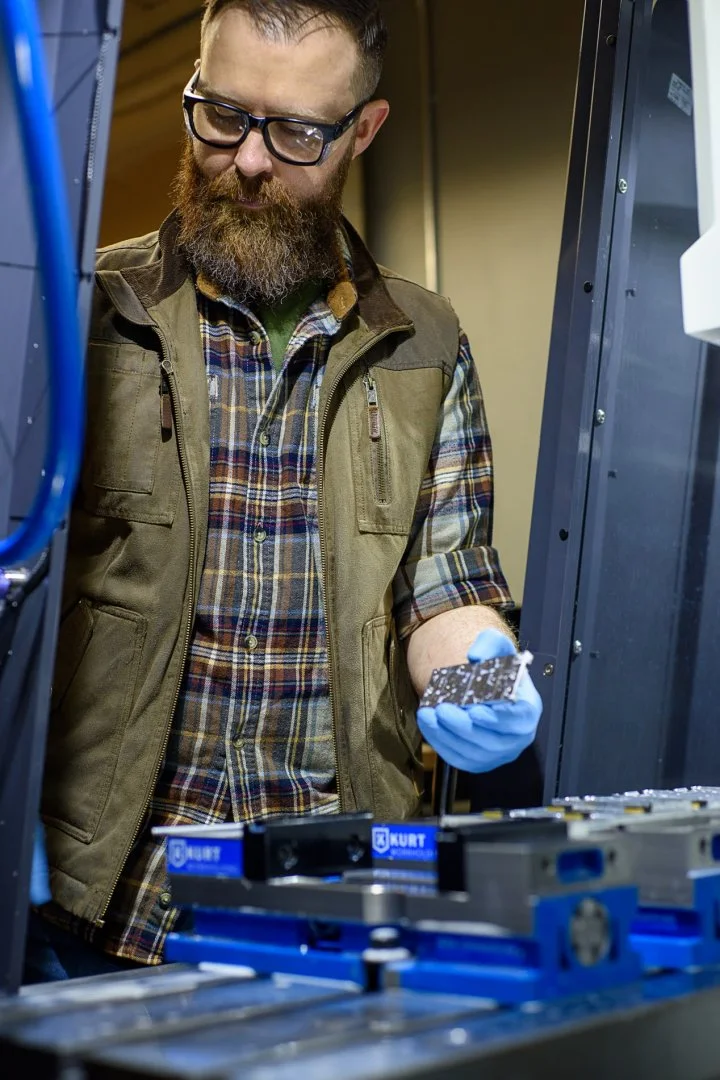
Small features and thin walls are the usual difficulty, and both come down to workholding rather than a different cutter. Fixtures are designed and cut here and kept afterwards.
Housings, plates and precision parts for instrument and sensor builders. The products ship under their name, not ours.
A fair amount of this work is cut from drawings for something nobody outside the company has seen yet.
An NDA sent with the RFQ comes back signed, and nothing about your product appears on this site or anywhere else.
Electronics parts are usually specified by what they have to achieve rather than by a tolerance block. These are the requirements that actually change how a part gets cut.
| What the part has to do | What that means here |
|---|---|
| Move heat away from a device | Flatness and contact area matter more than the outline. The mating face is finished last so it stays flat. |
| Sit flush against a populated board | The datum is the board, not the outside of the part. Component clearance gets checked against your assembly. |
| Insulate or isolate | Delrin, PEEK and PTFE move as they are cut and again as they warm up. They are held and paced differently than metal. |
| Shield or ground | Continuity depends on the finish. Tell us which surfaces must stay bare before plating is quoted, not after. |
Aluminum 6061 and 7075 for enclosures, plates and heat sinks. Brass and copper where conductivity or thermal transfer matters. Stainless 303, 304 and 316. Delrin, PEEK, UHMW and PTFE for insulating and low-friction parts.
Housings, plates and heat sinks where fit against a board or a chassis has to be right the first time.
Burn-in, probe and functional test hardware, built around your part rather than around a catalogue vise.
The four parts that prove the design before anyone commits to tooling.
Tell us the dimension and we will give you a straight answer rather than a general claim. Small features are usually limited by how rigidly the part can be held, so the fixture is part of that conversation.
Yes, and it is worth calling out which face it applies to. A flatness note applied to the whole part rather than the one surface that seals or conducts is a common reason a part costs more than it should.
Yes. Thin walls are a workholding problem, and workholding is designed and cut here rather than adapted from a standard vise. It is why thin-wall parts are quotable here instead of declined.
Anodizing, plating and passivation are coordinated through qualified outside vendors on your order, and parts come back here for inspection before they ship. Send the finish callout and we will confirm whether it is one we handle.
Yes, and it is often the more useful half of the order. Burn-in, probe and functional test hardware gets built around your part rather than around a catalogue vise, and the fixture stays here so a second one matches the first. How that works is on the custom fixtures page.
Quotes come back the next business day and the shop opens at 6 AM. Lead time depends on the part and whether a fixture is needed — ask and you will get a real date.
A STEP file, a drawing, or the part itself. Quotes come back the next business day, the minimum order is one, and you will be talking to the machinist who cuts it.